
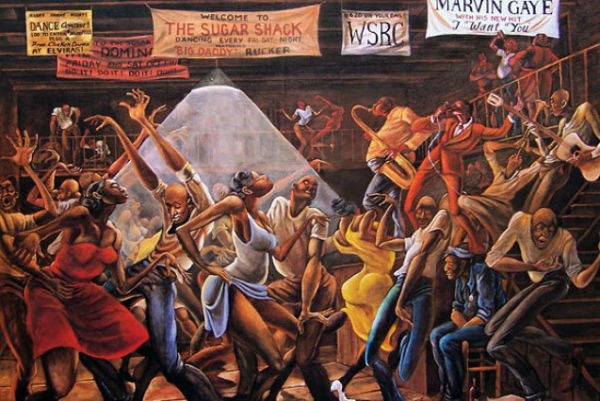
When Ernie Barnes’s Sugar Shack sold for $15.3 million at Christie’s in 2022, it shattered auction records and proved what HBCU art has always known: Black Southern excellence deserves museum walls and generational wealth.
But Barnes’s journey from North Carolina Central’s football field to art history wasn’t typical. It required defying coaches who saw his sketchbooks as distractions, teammates who questioned his masculinity, and an art world that rarely made room for Black athletes who dared to paint.
[(Image TBD – Fill in with placeholder)]
[Caption: Ernie Barnes at North Carolina Central University,
1950s]
Durham’s Reluctant Athlete
Born in Durham, North Carolina in 1938, Ernest Eugene Barnes Jr. never wanted to play football. He wanted to draw. But growing up during Jim Crow, being small, shy, and artistic made him a target for bullies. His solution? Transform his body through relentless physical training, earn respect through athletic dominance, then return to what he loved: capturing human movement on canvas.
At North Carolina Central University (then North Carolina College), Barnes studied art while playing football on a full scholarship. His professor Ed Wilson saw what coaches
couldn’t: Barnes’s athletic understanding of the body gave him something art schools couldn’t teach. He could paint motion itself—the torque of a jump shot, the lean of a dancer, the explosive power of athletes mid-collision.
[(Image TBD – Fill in with placeholder)]
[Caption: Barnes during his NFL career, 1960-1965]
The NFL Years: Painting in the Shadows
From 1960 to 1965, Barnes played for the Baltimore Colts, New York Titans (later Jets), San Diego Chargers, and Denver Broncos. He hated the violence. Hated the way football reduced human bodies to instruments of collision. But he studied every movement, filing away visual references that would later become his signature style: elongated limbs
suggesting grace under pressure, closed eyes conveying spiritual transcendence, bodies moving as one unified organism.
Between practices, he sketched. His teammates nicknamed him “Big Rembrandt.” Some respected it. Others thought he was soft.
In 1965, Barnes crashed an American Football League owners meeting in Houston without invitation. He pitched himself as the first official artist of a professional sports
franchise. New York Jets owner Sonny Werblin was intrigued enough to bring three art critics to Barnes’s makeshift studio. Their verdict: “the most expressive painter of sports since George Bellows.”
Werblin offered Barnes a player’s salary to paint full-time. Barnes retired from football immediately.
[(Image TBD – Fill in with placeholder)]
[Caption: One of Barnes’s signature dance hall scenes]
The Style That Changed Everything
Barnes developed what he called “neo-mannerism”—inspired by Italian Renaissance painters but applied to Black Southern life. His figures stretched and curved impossibly, their bodies suggesting music made visible. He painted pool halls and dance floors, family dinners and church services, football games and jazz clubs.
Critics initially dismissed his work as “illustrative” or “too narrative” for serious art consideration. Translation: too Black, too joyful, too accessible.
But television changed everything.
[(Image TBD – Fill in with placeholder)]
[Caption: Barnes’s work appeared throughout Good Times,
1974-1979]
Good Times and Cultural Ubiquity
When Good Times premiered in 1974, Barnes’s paintings appeared throughout the Evans family’s Chicago housing project apartment. The show’s character J.J. was an aspiring artist, and Barnes created every painting attributed to him—including works displayed in opening and closing credits.
Then in 1976, Marvin Gaye chose Sugar Shack for his album I Want You. The painting—a crowded dance floor of Black bodies in ecstatic motion—became one of the
most recognized images in American popular culture. Every week, millions of Americans saw Barnes’s vision of Black joy and community during Good Times‘ opening sequence.
[(Image TBD – Fill in with placeholder)]
[Caption: Marvin Gaye’s “I Want You” album featuring
Sugar Shack, 1976]
This wasn’t crossover success. This was cultural saturation.
[(Image TBD – Fill in with placeholder)]
[Caption: Another iconic Barnes work celebrating Black
community]
The Legacy: From NCCU to Museum Walls
Barnes died in 2009, but his market trajectory accelerated after his death. That $15.3 million Sugar Shack sale in 2022 wasn’t just a record—it was validation that work
dismissed as “too commercial” actually belonged in the canon.
Today Barnes’s work hangs in the African American Museum in Philadelphia, California African American Museum, North Carolina Museum of History, and Smithsonian American Art
Museum. Collectors including Bill Cosby, Magic Johnson, and Eddie Murphy built significant Barnes holdings. The estate, managed by his widow Berenice Barnes and now represented by Ortuzar Projects and Andrew Kreps Gallery, carefully releases works that continue selling for six figures.
[(Image TBD – Fill in with placeholder)]
[Caption: Barnes’s work continues to inspire contemporary
artists]
North Carolina Central honors him through exhibitions and scholarships. His influence appears in contemporary artists like Derrick Adams and Jordan Casteel—painters who also
depict Black leisure, Black community, Black bodies at rest and in motion.
[(Image TBD – Fill in with placeholder)]
[Caption: Barnes’s work in museum collection]
What Barnes Understood
Barnes knew something art critics took decades to accept: Black people at play, at rest, in community—this wasn’t “less serious” subject matter. It was revolutionary. In a
country that predominantly showed Black bodies suffering, Barnes painted Black bodies thriving. His football career gave him access to an athlete’s understanding of human kinetics. His HBCU education gave him technical rigor without forcing him to abandon his cultural specificity. His Southern roots gave him subject matter that felt like home.
The combination proved unstoppable.
[(Image TBD – Fill in with placeholder)]
[Caption: Ernie Barnes, artist]
Today, artists carry forward Barnes’s vision of Black joy as artistic subject matter: contemporary muralists reimagining public space as celebration, portrait painters documenting everyday excellence, multimedia artists translating community into visual language.